
How To Vent Basement Bathroom Fan
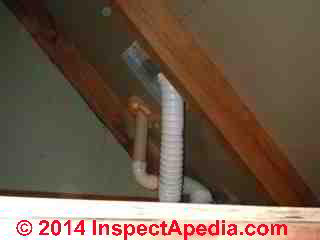 Bathroom Ventilation Fan Duct Routing
Routing a bath vent duct down & out or up through an attic or roof & out
- POST a QUESTION or COMMENT about bathroom vent fan and fan ducting installation procedures, codes, standards
InspectAPedia tolerates no conflicts of interest. We have no relationship with advertisers, products, or services discussed at this website.
Bath vent fan duct routing: up, through roof, down through floor or crawl area?
This article describes routing bath exhaust fan duct upwards through an attic or roof space or downwards through a floor or crawl space.
In all cases the ducting needs to conduct the exhaust to the building exterior and needs to terminate in an animal-proof vent cover. Which direction is better? Up or down? It depends.
This article series describes how to install bathroom ventilation systems, fans, ducts, terminations.
We include bathroom venting code citations and the text also explains why bathroom vent fans are needed and describes good bath vent fan choices, necessary fan capacity, and good bath vent fan and vent-duct installation details. \
We discuss bath vent routing, insulation, slope, termination, airflow rate requirements and other specifications.
We also provide an ARTICLE INDEX for this topic, or you can try the page top or bottom SEARCH BOX as a quick way to find information you need.
Where to Route Bathroom Exhaust Vent Ducts: up and out, down and out, over and out?
Ventilation in bathrooms is important to prevent moisture damage to wall and ceiling surfaces, decay of wood trim, saturation of building insulation, and mold contamination.
Here we will discuss: bathroom vent fans, required bath vent fan capacity, fan noise and sones. Bathroom vent fan ducts, where to route vent air, duct condensation, ceiling leaks; Photographs of both successful and unsuccessful or downright horrible bad bathroom exhaust fan or vent or duct installations.
Steven Bliss writes in a companion article at BATHROOM VENTILATION DESIGN, "Bathrooms produce moisture, odors, and VOCs from aerosols and various personal hygiene products.
Effective spot ventilation in these areas is critical for maintaining healthy levels of indoor humidity levels and an overall healthy indoor environment."
Especially in bathrooms where a shower is used, large amounts of moisture are added to room air and are concentrated in this area.
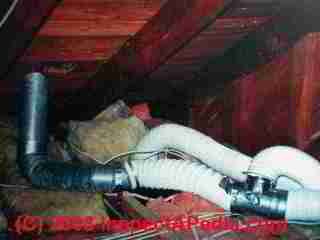
Our photo (above-left) shows a horrible bathroom ceiling vent fan ductwork job: multiple ducts sprawl around in the attic, all joining to terminate at an attempted through-roof vent that has fallen back into the attic.
Notice how wet the roof sheathing is in our photograph? These conditions are inviting an attic mold problem too.
Article Contents
- BATHROOM VENT DOWN THROUGH FLOOR / CRAWL AREA
- BATHROOM VENT DOWN in CATHEDRAL CEILING
- BATHROOM VENT OUT THROUGH SOFFIT
- BATHROOM VENT UP THROUGH ROOF
Bathroom Vent Fan Duct Routing
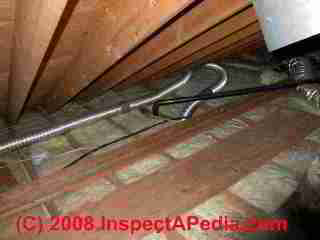
Flex duct routing details: If you are using flexible fan duct, stretch the flexduct tight to keep it as straight and smooth inside as possible.
Long sloppy bending flexduct runs significantly reduce the performance of the vent fan.
Connect the flexduct to the fan itself using plastic ties, or second best, duct tape. Keep all connections tight and avoid air leaks.
Vent the bathroom exhaust to outside: Both the model building codes and every manufacturer's bath vent fan installation guide that we reviewed emphasized: make sure that the bath vent fan carries moist air all the way outside of the building.
See details at BATHROOM VENT CODES
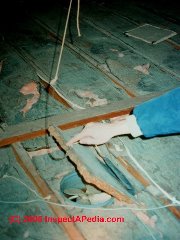 Do not spill bath vent air into the building attic or roof cavity where it will condense on and damage building insulation, roof sheathing, possibly framing, and where it will certainly encourage mold growth.
Reader Question: dangers of wet bath exhaust vent air re-entering the attic
Isn't there a danger of wet bathroom exhaust air re-entering the attic through the soffit vents if the fan is exhausted through the soffit? - Tony
Reply:
Tony
Our article BATHROOM VENTILATION CODES SPECS cites the importance of venting bath vent fans to the outdoors, not into an attic or crawl space.
The question about moist air reentering an attic through soffit vents after it has been blown out of an exhaust vent opening is a fair one, but I don't think that's likely to be a significant building moisture source. Once blown at any velocity into outdoor air, the moist bath vent exhaust air is diluted significantly.
Or speaking from empirical experience, having inspected several thousand homes and having looked very carefully at moisture and mold stains and patterns in attics and under roofs, I've not found any instances of back-venting of problem moisture into the attic through the soffit vents near the bath exhaust vent that presumably is blowing out through the same soffit or a nearby building vertical wall.
Bath exhaust fan duct length specifications and restrictions are discussed separately
at BATHROOM VENT DUCT LENGTHS.
Bathroom Vent Fan Routing Down & Out Through a Floor or Crawl Space
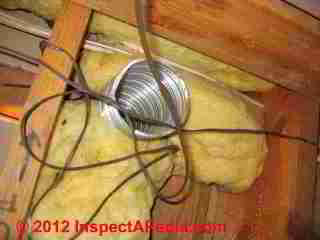 Question: OK to exhaust a bathroom fan under a crawl space or addition?
2016/09/12 Todd said:
We have built an addition to our house. The bathroom fan vent was run to the outside of the house but was removed as the addition surrounded vent.
The contract nicely wrapped the exhaust hose around the fan and installed the roofing with out re plumbing it.
All the floor joists have some kind of wiring or vents running through them. Would it be alright to exhaust the bathroom fan air under the addition as there is to vents on either side of the addition.
I would have to cut a hole through the wall to get to the next room to install the vent outside. This is a down stairs bath.
Reply: yes but ...
Todd:
I don't have a complete understanding of the situation. In general, you can try venting a bath vent fan "down" but the combination of down-direction, elbows, and total run length may mean that it's ineffective.
Take a look at the installation manual for your fan brand and model. The manufacturer will give guidance on the total duct length permitted. Adding elbows and bends increases the "effective" duct length (shortening what's allowed) as would blowing "down".
Details about length restrictions on exhaust ducting are
at BATHROOM VENT DUCT LENGTHS
I've seen OPINION by some builders and web page authors that venting a bath vent "down" is "best" and that it "respects the laws of physics". I'm not sure what physics class those authors attended.
Warm air wants to rise in a building or in ductwork, so pushing that warm bathroom air "down" and out is harder for a bath fan than blowing it upwards and out. The authors who like to blow down are perhaps mixing up the importance of avoiding backdrafts with the importance of providing a vent duct size, routing, length that make the fan work effectively.
Perhaps some confusion about up or down venting also arises because it IS good practice for an overhead fan duct to slope down 1/8 to 1/4" per foot so that any condensation in the fan drips out of the wall vent or soffit vent rather than back into the bath ceiling.
I also prefer using solid metal duct or solid PVC piping as a bath vent fan duct rather than thin mylar or plastic flex duct - you'll get better and safer airflow.
Bath Vent Termination Cover
At the wall termination you'll need to install a vent termination cover that
- Closes to prevent back-drafting when the fan is not running. Typically the cover closes by gravity and works fine.
- Prevents critters from entering or nesting in the duct system
It's smart to insulate the vent ducting too, reducing condensation in the duct from exposing the warm moist bath air to cooler crawl space (or attic) air.
Details inculding allowable mesh opening sizes for bath vents are
at BATHROOM VENT DUCT TERMINATION
Bath Vent Indoor Air Intake Location
Locate the bath vent fan high in the bathroom - high on an exterior wall when you can, or on the ceiling where it can pick up steamy air from a bath shower.
Watch out: as we warn elsewhere, if a bath fan or light is close to or can be touched by someone in a tub or shower it must be on a ground fault circuit interrupter (GFCI) protected circuit lest your installation kill someone who's naked and wet.
Bath Exhaust Fans Routed Up Through the Roof
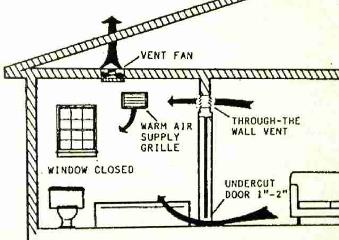 Reader Question: is it OK to vent a bath vent fan straight-up, vertically out through the roof? Is it ok to vent the bath vent fan through a larger duct size than the fan's outlet diameter?
I am going to install a new bath fan, I am having a new roof put on the house and decided now would be a good time to put the vent on the roof.
My question is I got a vent for 6" ducting, I will need a reducer at the fan end to 4" Would this be a good size duct for the fan.?
Also I an using metal ducting and it's about six feet from the fan to the roof,
Should I angle the duct a little or would it be ok to go straight up.? D.K. 10/19/2013
Reply:
You've raised several key topics, and your question helps us realize where we need to work on making our text more clear or more complete.
A competent onsite inspection by an expert usually finds additional clues that would permit a more accurate, complete, and authoritative answer than we can give by email alone.
For example on site I might notice something about your attic and roof structure, ease of routing venting, placement of insulation, and even very basic stuff like - where the heck is your home? Bath ventilation worries may be a bit different in a cold climate than in a warm dry one and different again in a wet humid climate. That said I offer these comments:
Local Climate Affects Good Bath Vent Fan Designs: freezing vs hot and humid
For freezing climates we don't want to risk ice accumulation in the vent system - ice can collect from freezing condensate that arrives inside the bath vent duct during hot steamy showers;
For hot humid climates we don't want to have condensate accumulation in air conditioning systems and A/C ductwork, but a bath vent run through a hot attic is less likely to raise that same issue.
Bath vent routing vertically up through roof - not my first choice
I prefer to run a bath vent to outdoors via a horizontal line that goes across an attic and out through a gable-end wall or one that vents down and outside through a roof overhang or soffit.
The vent run needs to be designed to drain any condensate outside not back into the bathroom ceiling; in a freezing climate I'd insulate such a vent line as well; If we run a bath vent vertically up through a roof we have two risks I'd prefer to avoid:
The vertical run guarantees that any condensation runs back down into the fan (risking damaging the wiring or fan motor) and back into the bath or bath ceiling.
The vertical run also means another roof penetration. I prefer to minimize the number of roof penetrations on any building since every penetration is a potential leak point, more so if the penetration flashing is not installed correctly.
Bath vent diameters & vent duct materials
The vent fan manufacturers installation instructions typically give maximum run lengths and recommended vent diameters for their products; long vent runs and vents that use plastic dryer-type flex-duct (not your case) cut the effectiveness of the fan by adding airflow resistance and thus increase the risk of accumulated moisture too.
Metal duct work (your case) is in my opinion always a better installation: smooth interior means better airflow. Metal fan vent ducting also reduces the risk of duct crush or collapse.
I am guessing that for a very short bath vent duct run, going to a larger duct size is fine - it'd make no difference but you're probably not gaining a thing on a short run by using a 6-inch duct to vent a fan that expects to vent through a 4-inch duct.
Bath vent fan capacity
In my experience inspecting and troubleshooting buildings, I've seen many bath vent fans that seemed ineffective. A fan that nobody uses because it's too noisy means a bathroom that is rarely vented adequately (risking mold, smells, even wet insulation). A fan that is under-powered means even if the fan is used it doesn't do anything.
Typical bathroom ventilation codes such as the 2006 IRC specify that a bathroom (toilet) vent fan must provide 20 cfm if the fan runs continuously and 50 cfm if the fan runs intermittently, presumably switched on and off manually or by a timer.
The actual fan venting capacity (in CFM) that you need depends on the size of the bathroom being vented - usually calculated in cubic feet. That figure is matched against the fan manufacturer's recommendations for fan capacity measured in cubic feet per minute (CFM).
The CFM rating of the fan in turn presumes that the vent routing, diameter, length, and number of obstructing turns and bends is within the company's specifications. In the article above we explain how to calculate the required bathroom vent fan capacity
Also, for bathrooms over 100 sq ft, the HVI recommends a ventilation rate based on the number and type of fixtures as shown in Table 6-12 - data discussed in more detail
at BATHROOM VENTILATION DESIGN
Sorry that these notes are a bit long on arm-waving and short on more specific details, but as we've got no information about your particular installation except what's in your original note, I have to stop here.
Vent Fan Termination: Exhaust to the Outdoors
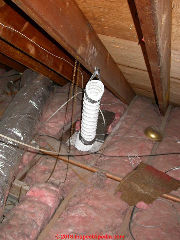
Watch out: do not simply terminate a bath vent fan duct in an attic as shown in our photo above, nor can you just dump the exhaust vent into a crawl space nor into a closed wall, floor or ceiling cavity.
The exhaust vent must terminate outdoors. Otherwise you're inviting a moisture, mold, rot, insect problem in the building.
See BATHROOM VENT CODES for details of the building code and manufacturers' requirements to terminate exhaust vents outside.
Watch out: do not simply connect a bathroom exhaust fan duct to a kitchen exhaust duct system.
See BATH KITCHEN VENT DUCT SHARING for details.
See BATHROOM VENT DUCT TERMINATION for complete details about how to terminate the bath exhaust vent duct.
Question: roofer says that at re-shingling time he is required to vent bath exhaust through roof?
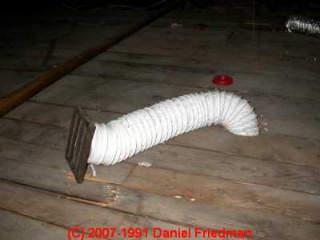 For a private home built in 1969 before any ventilation code existed, is the current Virginia code requirement for exterior ventilation of existing bathroom fans required incident to shingle replacement? (The roof shingle replacement is not in any way adding, changing or replacing a fan.)
Contractor wants access to the attic, will charge o/a $200 for each existing bathroom fan exterior exhaust to meet VA Code)
Contractor claims it is required.
I have serious doubt this is a money making attempt. Please comment. - Anonymous by private email 2018/09/11
Reply: re-shingling may not step on the toes of bath exhaust venting directly but it does indirectly: you should vent bath exhausts outside
Generally and in most building code jurisdictions, existing buildings are not required to be updated to current building codes except where new work or remodeling or renovations affect or disturb the original work or area to which a code or regulation applies.
The legal and thus legally correct answer to your question is in the hands of your local building code compliance officer as she is the final legal authority where you live.
That said, I have these comments:
Regardless of whether or not an improper building practice is "legal" or not, if it is one that is likely to cause unsafe conditions or costly damage it should be corrected.
Dumping bathroom exhaust into an attic or under-roof space invites costly mold contamination, frost under the roof in freezing climates, moisture damage to roof sheathing, possibly even plywood delamination or rot, roof failures, and shorter roof shingle life. It may also violate a shingle warranty.
Bathroom exhaust venting does not have to exit up through the roof, and in fact that's not necessarily even the best termination. An exhaust vent fan can exhaust out through a gable end side wall or out through a soffit overhang.
And of course a bathroom with a window doesn't require an exhaust vent.
However your roofer is correct that bathroom exhaust venting is desirable, to avoid indoor moisture problems that can extend to the attic, roof sheathing and can affect roof life.
For example a shingle manufacturer may refuse a warranty claim if an attic or roof cavity is not properly ventilated - a topic you don't mention - and an inspector of a roof or other building claim and who finds abnormal moisture or moisture damage (or mold) in an attic might refuse a claim if she finds that the moisture is attributed to improper bath venting that, for example, simply dumped bath moisture into the attic space.
If your bath vent vans presently dump into the attic space they are improper, have always been improper since original installation, risk damage to the home including examples I've give and others too, and the venting should be corrected.
Bath Exhaust Fan Routed Down Through Cathedral Ceiling or Down-Sloping Roof to Soffit
This topic has moved to a separate article found
at BATHROOM VENT DOWN in CATHEDRAL CEILING
Reader Q&A - also see the FAQs series linked-to below
Dave
Let's avoid my wish to be arm-waving and get to the experts:
BATHROOM VENT DUCT MATERIALS
describes the materials and properties of bath exhaust vent ducting.
Plastic flex-duct is not prohibited per-se, but depending on what it's made-of and its listing (or not) for use as a bath exhaust duct
Watch out: the particular duct that you have installed might not be fire-safe - that's the concern, not the fact that your duct is insulated.
Often a contractor is knowledgable and honest, but may not have been an English major; try asking for a more explict explantion than just "it's illegal".
Your duct must be listed and meet fire code requirements as given in the citation I've provided.
What costs are involved in changing your bath exhaust vent? Over what length? Are there difficulties of access to the ducting?
I'm getting conflicting information regarding the proper ductwork for installing of a bathroom fan Florida. The run is relatively short about 7 feet, venting out the attic. We used flexible insulated ductwork, but we just had another HVAC guy tell us that is wrong. It should be flexible metal piping not insulated. That just doesn't make sense to me. How could insulated duct work be wrong? I don't want to spend more money to change it. I would appreciate your thoughts.
Jeff
I'm not sure what's meant by "attic blower unit" but if that means a power vent that exhausts to the outside of the building that may be ok.
The builder's remark is in my opinion not reliable. Just because we see a feature or condition at a building it by no means indicates that that detail was ever inspected by nor approved by a code official nor other expert.
Builder says it would not have been approved/inspection if it wasnt alright...
Four month old house lowcountry of S Carolina, just noticed NO exterior bathroom venting... attic inspection difficult looks like maybe 3 bathrooms are vented back to attic blower unit??? Never heard of such 'up north'.... OK down here???
OK stay safe and well.
Thank you for responding. I'll be talking to someone local about getting things updated.
That doesn't sound like a proper installation to me, either, Al.
When the fan is running it may interfere with proper venting of other building drains, and in some circumstances could be both a health and a safety hazard. (Methane gas explosion or airborne pathogens).
When the fan isn't running I can't say for sure what'll happen but can't rule out back-drafting of sewer gases into the occupied space.
You should have the bath vent disconnected and routed outdoors and the opening in the vent pipe sealed.
Watch out: when I come across creative work such as that you've described (bath exhaust connected to building plumbing vent) it's a red flag to watch out for other improper work that may have been done by the same person in other building areas.
Hi there...
While recently repairing an exhaust fan motor in our bathroom I discovered that it's exhaust is hooked into our sewer stink pipe.
Everything is built with ABS pipe which comes up through the insulation and connects to another ABS vent pipe that then connects to our main 6" sewer exhaust vent
Our concern.... is there a possibility that the sewer gas could enter the bathroom. Would the gases eventually make their way back down the pipe to the bathroom or would it take the bath of less resistance and head straight up and out. I'm unaware if a baffle was installed by the previous owner to prevent any back gases.
TY in advance
Josie
Yes if the bathroom exhaust fan is not properly routed so as not to accumulate nor leak condensate into the ceiling above.
The vent shouldn't be dead flat but should drain either back to the fan or down to the building exterior.
And if flex duct was used that sags easily and may be retaining water or even leaking.
Some direct further investigation is in order.
When window is closed in my bathroom, there is a distinct odor of mold or mildew. I believe it is from the ceiling exhaust vent with light. This was installed less than 3 years ago. It leads outside to the wood wall trim above our brick exterior, and under, but not on the soffit. the vent in the attic was not placed on a horizontal line, but zigzagged through the attic rafters. Could this be the problem that condensation has built up, creating mildew or mold?
Please answer my question at my email posted above. My roofer completed their job last July 14, 2020. While it is sunny in San Diego at this time, I am concern that without a cover, rain might wet &damage the motor of my bathroom vent that is perfectly working right now. I do not want rain to be pouring into my bathroom during the winter season.. What do I do & when will I get a reply from InspectApedia?
I a new roof job done by a licensed contractor. My upper bathroom vent is through the roof out into open air. Before the roofing job I had a working bathroom vent but i could not see directly into the sky. Now I could see the sky even if the fans blades are working perfectly. I am concern that there was a cover that became missing from the roofers job. I cannot go up the second storey roof to see for myself. Should I tell the roofer to return the (cover?) whatever it was that was there so I am not staring openly at the sky? Respectfully Maristel
Thanks for the comment, Mike. I agree.
Moving air "down" is easier IF the air is heavier than surrounding air in the environment. That's why we may put an air conditioner air handler in an attic to blow cool air down to the floor below.
Moving air "up" is easier IF the air is lighter than surrounding air in the enironment. That's why it's easier to blow warm air up when heating a building.
So an air conditioning air handler in the basement is going to have a harder time blowing cool air up to the second floor in a home in a hot climate.
Which is to say, all else being equal,
it's easier to move cool air down and to move warm air up.
air has mass. mass is affected by gravity.... fans are sized to move the mass of the air. moving air downward could be easier in many scenarios.
There are a couple of considerations, Ed, in routing that basement bath exhaust fan duct.
1. total duct length may exceed the fan capacity
2. adding elbows to get around obstructions is permitted (yes you might want to include a condensate drain plug), but elbows, too, increase the equivalent duct length.
Bath exhaust fan duct length specifications and restrictions are discussed separately
at BATHROOM VENT DUCT LENGTHS https://inspectapedia.com/ventilation/Bathroom_Vent_Duct_Lengths.php
There you'll see how we compute the maximum duct length based on individual fan specs;
Not to worry, there's always a solution, such as using larger diameter ducts.
About installing a fan in the wall - if the bathroom has an exterior wall that's sufficiently above grade then that may be a better option. Just be sure your exhaust fan termination is sufficiently above both ground level and, depending on where you live, above the high snowfall level.
@Joel,
Question for you..I'm installing an exhaust fan in a basement bathroom and to get it out doors I have to vent to a joist Bay and out trough the side of the house about 40 feet.but to get around some existing duct work I have to pipe it down and around it and go back up to connect to the longer 40 ft strait run.is that ok or is it at risk for collecting moisture?I might be able to install the fan in the wall to avoid this
Sorry CJ
Clark's come in box code does not permit or accept videos or recording files. It will accept an image file for each comment. You can try sending something to our contact information email.
I sent you a question I somehow can't find it. I uploaded a video of the dust sticky fur
It's late so I guess hopefully I didn't lose the question I asked in the process. I'm sure it went through mahalos
Yes, good velocity, short run, helps.
Follow-up with periodic inspection, especially for clogged jammed exit flapper door on the vent.
I look fwd to seeing a photo as installed.
Thanks Dan. I have all the same concerns, but can't see a better solution. It's a 300CFM fan, & the run would be max 5 feet, so I'm thinking the higher velocity will throw the exhaust far enough to allow adequate dilution. Thanks again. I love these forums
...
Continue reading at BATHROOM VENT DUCT LENGTHS or select a topic from the closely-related articles below, or see the complete ARTICLE INDEX.
Or see BATHROOM VENT DUCT ROUTING FAQs - questions & answers about vent duct routing posted originally at this page.
Or see these
Recommended Articles
- BATHROOM VENTILATION CODES SPECS - home
- BATHROOM VENTILATION DESIGN
- BATHROOM FAN ENERGY COST
- BATHROOM FAN HEAT RECOVERY
- BATHROOM VENT FAN SIZING & NOISE RATINGS
- BATHROOM FAN WIRING
- BATH KITCHEN VENT DUCT SHARING
- BATHROOM VENT AIR SUPPLY
- BATHROOM VENT CLEARANCES
- BATHROOM VENT CODES
- BATHROOM VENT DUCT LENGTHS
- BATHROOM VENT DUCT MATERIALS
- BATHROOM VENT DUCT ROUTING
- BATHROOM VENT DUCT INSULATION
- BATHROOM VENT DUCT SLOPE
- BATHROOM VENT DUCT TERMINATION
- BATHROOM VENT DUCT PROTECTION
Suggested citation for this web page
BATHROOM VENT DUCT ROUTING at InspectApedia.com - online encyclopedia of building & environmental inspection, testing, diagnosis, repair, & problem prevention advice.
Or see this
INDEX to RELATED ARTICLES: ARTICLE INDEX to BUILDING VENTILATION
Or use the SEARCH BOX found below to Ask a Question or Search InspectApedia
...
Ask a Question or Search InspectApedia
Try the search box just below, or if you prefer, post a question or comment in the Comments box below and we will respond promptly.
Search the InspectApedia website
Note: appearance of your Comment below may be delayed: if your comment contains an image, web link, or text that looks to the software as if it might be a web link, your posting will appear after it has been approved by a moderator. Apologies for the delay.
Technical Reviewers & References
Click to Show or Hide Citations & References
Publisher InspectApedia.com - Daniel Friedman
How To Vent Basement Bathroom Fan
Source: https://inspectapedia.com/ventilation/Bathroom_Vent_Duct_Routing.php

0 komentar:
Posting Komentar